
Middle Street in the ghost story and Middle Street on today’s map are not the same road. The Peter Rugg tale, one of New England’s best-known missing-man stories, sends a stubborn Bostonian home from Concord in a storm and leaves him wandering the roads forever, asking the way to Boston. In the story, he lives on Middle Street. That Middle Street was a main street of the North End, later folded into Hanover Street. The Middle Street in South Boston is a different street, and it does not come with a documented haunting of its own. This post treats the legend as literature and folklore, and it keeps the two streets straight.
What the record shows
“Peter Rugg, the Missing Man” was written by William Austin, a lawyer from Lunenburg, Massachusetts, and first printed in 1824 in the New England Galaxy, according to the New England Historical Society. It appeared as a letter from “Jonathan Dunwell,” a name Austin used as a narrator, not as a signed news report. The story was widely reprinted, sometimes in ways that left readers unsure it was fiction, and it was later collected in Samuel Adams Drake’s A Book of New England Legends and Folk Lore (1910). Austin’s literary papers were gathered in a volume published in 1890.
In Austin’s tale, Peter Rugg lives on Middle Street in Boston with his wife and daughter. One autumn, in the story’s 1770 setting, he drives his daughter to Concord. On the way back a violent storm overtakes him. At dark he stops in Menotomy, a village Austin’s text already identifies as “now West Cambridge” and that is today part of Arlington, at the door of a friend who urges him to stay. Rugg refuses. Austin gives him this speech, “with a fearful oath”: “Let the storm increase. I will see home to-night, in spite of the last tempest, or may I never see home!” He drives on and is not traced beyond that door. In later scenes he is met on New England roads, always wet, always asking the way to Boston, and never arriving. One episode in the story has a toll-gatherer on Charlestown Bridge throwing a stool at a horse and carriage that seems to pass without paying; the stool, the toll-gatherer later claims, went through the horse.
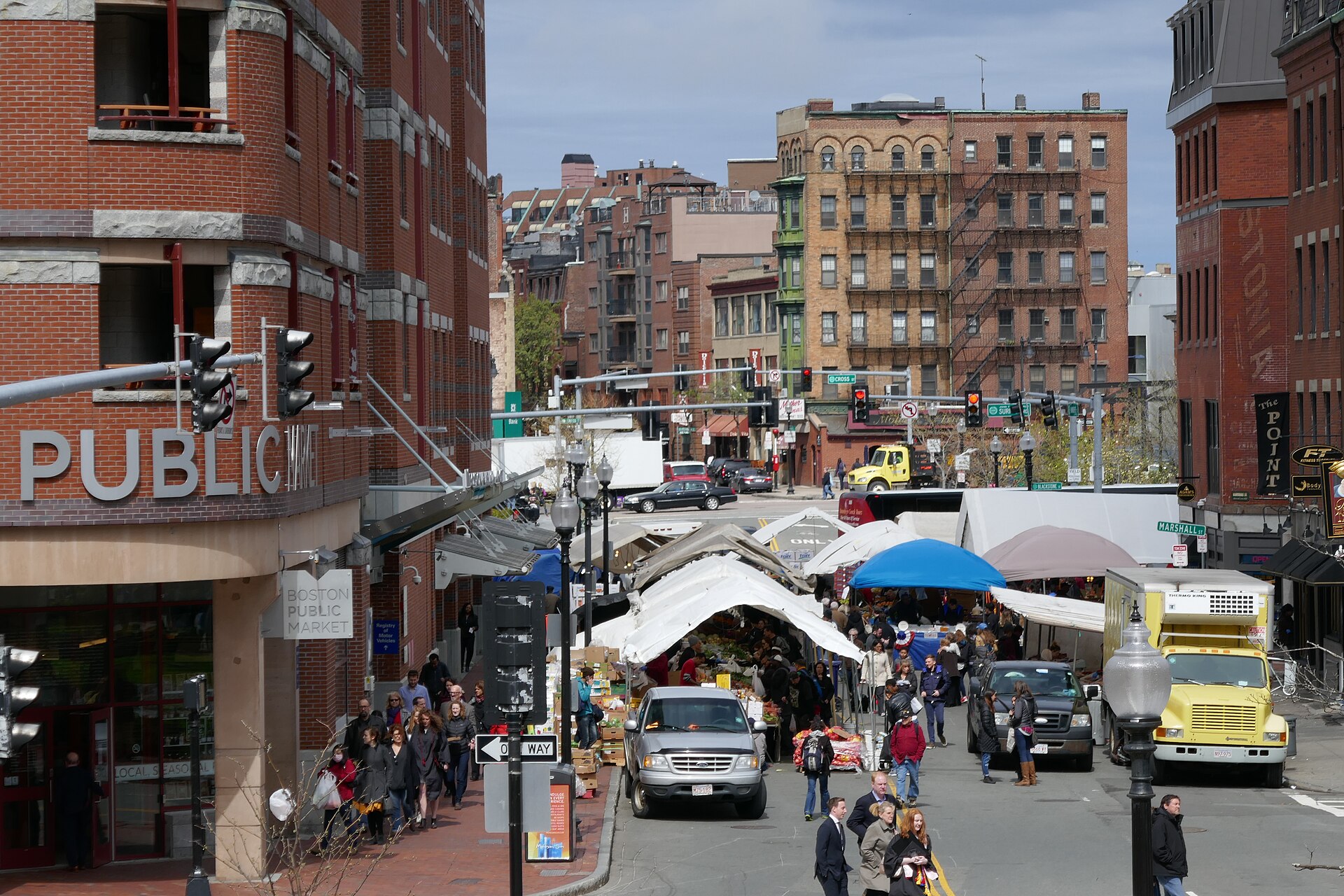
The Middle Street in that story is a North End street. Boston’s official 1910 street record, cited in the Wikipedia entry for Hanover Street, says that in 1824 — the same year Austin’s story was published — the former Middle Street, along with a stretch then called North Street, became part of Hanover Street, the main street of the North End. Maps of Revolutionary-era Boston already show both a Hanover Street and a Middle Street in that part of town. Today’s Hanover Street is a public, well-traveled street of shops, restaurants and houses. It is not a back road, and it does not need a special permit to walk.
Boston also has a Middle Street in South Boston. That is a different street. The short post this article replaces already noted that South Boston’s Middle Street does not appear in municipal or newspaper records as the site of a distinctive disaster, and that no oral tradition or paranormal account was found claiming that a phantom Peter Rugg appears there. That conclusion still holds.
The legend
The power of the story is literary. Austin wrote it as a mystery related by a traveler, and some later magazines reprinted it as if it might be true. The New England Historical Society notes that the tale was “even taken for truth on occasion,” and that Nathaniel Hawthorne mentioned Rugg in A Virtuoso’s Collection. Later retellings and local ghost tours have kept the cursed traveler on the roads and sometimes on the Charlestown Bridge, especially in bad weather. Those later tellings grow out of Austin’s fiction. They are not independent eyewitness records.
The story also plays on a real feeling of a city that had changed. When Rugg, in the tale, finds his way back to Middle Street, the houses and neighbors are not as he remembers them, and he decides he must be in “some other Middle Street.” Austin was writing in 1824 about a man unstuck from 1770. By then the colonies had become a country, and the street name itself was being retired.
What the record does not support
No historical record reviewed for this post establishes Peter Rugg as a real person, and Austin’s story was published as fiction. There is no documented accident, disappearance or court case behind the character. Quotes about the storm, the oath and the bridge come from the 1824 tale, not from a newspaper of 1770.
Nothing in the sources ties the legend to the modern Middle Street in South Boston. Using that street as a haunted highway would mix up two places that share a name. If the story has a geography, it is the old Middle Street of the North End, now Hanover Street, and, in one scene of the fiction, Charlestown Bridge.
Visiting
You can walk Hanover Street in the North End at any ordinary hour. It is a busy city street. Stay on the sidewalk, watch for traffic and for the Haymarket closures that sometimes shut a stretch of the street to cars, and do not treat shops, doorways or residences as tour stops. The Charlestown Bridge area, along North Washington Street today, is likewise a public crossing, not a haunted attraction. There is no Rugg house to find, and no reason to knock on doors.
Nearby are the ordinary historic walking routes of the North End and Charlestown — the Freedom Trail, Copp’s Hill and the waterfront — which have a deep documented history of their own. None of them needs the Peter Rugg story to be worth a visit, and the story does not turn any of them into a ghost site.
Frequently asked questions
Did Peter Rugg really live on Middle Street?
No. He is a character in an 1824 short story. In that story, he lives on Middle Street in the North End.
Is today’s Middle Street in South Boston haunted?
No documented haunting was found for that street. It is not the Middle Street of the story.
What happened to the Middle Street in the story?
It became part of Hanover Street in 1824, the same year the story was published.
Where does the Charlestown Bridge come in?
It appears in Austin’s story, in an episode about a toll-gatherer. Later retellings repeat it. It is not a documented haunting.
More haunted roads: Clinton Road (West Milford, NJ) and Highway 12 (near Frederica, DE).
Sources
- New England Historical Society: “Peter Rugg: The Missing Man Finds a Literary Home”: Austin’s authorship, the 1824 New England Galaxy publication, later reprints and literary influence.
- William Austin, “Peter Rugg, the Missing Man,” as reprinted in Samuel Adams Drake, A Book of New England Legends and Folk Lore (1910), via Wikisource: the text of the story, including the Middle Street setting, the oath and the Charlestown Bridge episode.
- Literary Papers of William Austin (1890): collected edition of Austin’s work, with a biographical sketch by his son.
- Wikipedia: Hanover Street (Boston): the 1824 consolidation of the former Middle Street into Hanover Street, citing Boston’s 1910 street record.
- Boston Street Laying-Out Department, A Record of the Streets, Alleys, Places, etc. in the City of Boston (Boston: City Printing Department, 1910): the official street-name record cited above.
Top image: Hanover Street closed to traffic for Haymarket, Boston, NewtonCourt, CC BY-SA 4.0, via Wikimedia Commons. This shows today’s Hanover Street in the North End, which includes the historic Middle Street of the story, not Middle Street in South Boston.